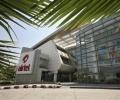
Bharti Airtel on Tuesday announced that it has scrapped the minimum recharge plan of Rs 99 in seven circles -- Andhra Pradesh, Bihar, Himachal Pradesh, Karnataka, Northeast, Rajasthan, and Uttar Pradesh (West). In these circles, the price of the entry-level plan now would be Rs 155. This 57 per cent increase in Airtel's entry-level plan comes two months after the telco discontinued the Rs 99 plan in Haryana and Odisha in November last year.

Over the past four quarters, the Sensex companies' earnings trajectory has improved sharply because of a weak rupee.

Equity benchmark index Sensex buckled under selling pressure for the second straight session to close below the 65k mark on Friday, as investors offloaded IT, teck and metal stocks amid a bearish global trend. Besides, fresh foreign fund outflows also hit investor sentiments, traders said. In a volatile trade, the 30-share BSE Sensex declined 202.36 points or 0.31 per cent to settle at 64,948.66.

Flipkart, the e-commerce company owned by Walmart, is intensifying its efforts to achieve profitability as it is eyeing a valuation of approximately $60 billion at the time of its initial public offering (IPO), now planned in 2025-2026, instead of this year, according to people familiar with the matter. The firm might consider listing in the US or any other geography, including India. The company, which counts the likes of Amazon and Reliance's JioMart among its competitors in India's burgeoning e-commerce market, had also contemplated launching an IPO in 2022-2023.
Omkeshwar Singh, head, Rank MF, a mutual fund investment platform, answers your queries:

It has suggested OTTs be subject to the same security requirements that a traditional TSP has to adhere to.

Jio Platforms is expected to use its 388 million mobile phone subscribers as the cornerstone of an e-commerce and digital services business to rival Amazon and Walmart's Flipkart.
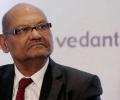
Mining magnate Anil Agarwal's conglomerate on Friday announced a major business shake-up, with flagship Vedanta Ltd approving a spin-off of its metals, power, aluminium and oil and gas businesses into separate listed entities and an overhaul of lucrative zinc unit planned as part of value creation and reducing debt load. Vedanta will issue one share of the five demerged businesses for every share held in the company, the firm said in a statement. The entire exercise, which would require shareholder and lender approval as well as a nod from the stock exchanges and courts, is expected to be completed in 12-15 months, its president for finance Ajay Agarwal said.

Billionaire Mukesh Ambani has set targets for his three kids whom he has identified for takeover of telecom, retail and new energy business. Speaking at his father Dhirubhai's anniversary, celebrated as Reliance Family Day, he said the oil-to-telecom-to-retail conglomerate Reliance industries Ltd has embarked on a journey of comprehensive self-transformation. "The end of 2022 is when Reliance will have crossed the half-way mark of its Golden Decade.
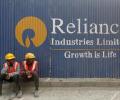
Reliance Industries shareholders will have to pay only 25 per cent for subscribing to the company's mega Rs 53,125-crore rights issue, and the balance will have to be paid in two instalments in May and November next year, the company said.

Anil Ambani will take over as the chairman of Pipavav Defence

Telecom and petchem businesses will drive growth for RIL.

From the Sensex pack, Infosys jumped the most by 3.67 per cent. Asian Paints, HCL Technologies, Reliance Industries, ICICI Bank, Wipro, NTPC, Tech Mahindra, Bajaj Finserv and Larsen & Toubro were among the other major gainers. State Bank of India, Bajaj Finance, Titan, Tata Steel, Tata Motors and UltraTech Cement were among the laggards.

Is it is necessary to play divisive politics to succeed in the next general elections? asks Dr Sudhir Bisht.

Markets were also weighed down by losses in index heavyweights Reliance Industries and Infosys.
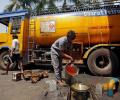
After a spike in crude oil and gas prices in October following the Hamas terror attack, prices eased down 9 per cent month-on-month in November. The Organization of the Petroleum Exporting Countries (Opec) and Opec+ agreed to a further voluntary production cut in January-March 2024 to try and support global crude prices. The best guess here is that crude prices (currently at $75/barrel, or bbl) will not likely cross significantly above $80, and gas prices are also likely to remain subdued unless there's a further escalation in the Israel-Hamas conflict.


The company, which is bullish on its growth prospects, plans to double the gold coin sales from the current 1,000 kg by the end of the current financial year.
India's richest man Mukesh Ambani celebrates yet another milestone todayhe turns 50!

Benchmark equity indices Sensex and Nifty closed higher by more than half a per cent on Wednesday following buying in IT, financial and oil stocks after the RBI slowed down the pace of interest rate hikes. Ending its two-day slide, the 30-share BSE Sensex rebounded by 377.75 points or 0.63 per cent to close at 60,663.79 with 24 of its constituents posting gains. The broader Nifty of the NSE spurted by 150.20 points or 0.85 per cent to settle at 17,871.70, riding on a rally in Adani Enterprises, Adani Ports and HDFC Life.

Indian Oil Corporation (IOC), Bharat Petroleum and Hindustan Petroleum may post a combined loss of Rs 10,700 crore in June quarter on selling petrol and diesel at rates below cost, a report said on Monday. While the raw material (crude oil) prices soared in April-June, petrol and diesel prices were not revised, leading to marketing losses which offset strong refining margins, ICICI Securities said in the report. The three state-owned oil marketing companies -- IOC, BPCL and HPCL -- control 90 per cent of the retail petrol and diesel sales in the country.
According to the report, the global economy is projected to strengthen this year, with growth picking up in developing countries.

The five private DTH operators (Dish TV, Tata Sky and Sun Direct being the other three) are expected to add over six million new subscribers by the end of December, to take the overall subscriber base to over 17 million, a 57 per cent growth over December 2008.

Benchmark indices settled lower on Friday, with the Sensex declining 111 points on the back of a sharp fall in index heavyweight Reliance Industries. The BSE benchmark went lower by 111.01 points or 0.21 per cent to settle at 52,907.93. During the day, it tanked 924.69 points or 1.74 per cent to 52,094.25. The NSE Nifty dipped 28.20 points or 0.18 per cent to close at 15,752.05.
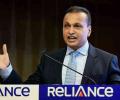
Reliance Infrastructure Ltd on Wednesday said its shareholders have approved raising funds up to Rs 550.56 crore through issuance of shares on a preferential basis. The funds raised would be utilised for long-term resources, for general corporate purposes and to fund future growth, the company said in a regulatory filing.

This is the sixth of seven ships built under 'Project 17 Alpha' for the Navy. The first five ships of the project were launched between 2019 and 2022.

An improved showing of mutual funds (MFs) is helping the industry attract distribution talent at a brisk pace. The industry has onboarded a net of 11,600 individual distributors in the first seven months of 2023-24 (FY24) compared to just 5,555 distributors in the whole of 2022-23 (FY23), according to data from the Association of Mutual Funds in India. Like most financial products, MFs also have significant reliance on individual distributors to sell their products, even as digital platforms are gaining popularity.

Net sales rose 26 per cent but profit rose at a slower 22.7 per cent, as operating margins took a hit by 160 basis points, year on year.

Modi said New Delhi has emphasised on dialogue and diplomacy along with restraint to deal with the situation arising out of the Hamas-Israel conflict.

Nikunj Saraf, Vice President Choice Wealth, answers your queries.
Billionaire Mukesh Ambani on Monday laid bare the succession plan at India's most valuable company, identifying twins children Akash and Isha for telecom and retail leadership, and youngest son Anant for new energy unit. He, however, insisted he isn't retiring yet and will "continue to provide hands-on leadership as before". At the annual shareholders' meeting of Reliance Industries Ltd, he said the robust architecture that he has announced will ensure the firm remains "a unit, well-integrated and secure institution even as it develops existing businesses and adds new growth engines."

With Mukesh Ambani taking over Network 18, the space for disseminating a diverse range of views could shrink, feels Paranjoy Guha Thakurta.

The market capitalisation of BSE-listed firms jumped to an all-time high of Rs 304.53 lakh crore on Wednesday, buoyed by an unprecedented rally in equities where the BSE benchmark Sensex ended over the 67,000-mark for the first time ever. Rallying for the fifth day running, the 30-share BSE Sensex climbed 302.30 points, or 0.45 per cent, to end at its lifetime closing high of 67,097.44 points. During the day, it jumped 376.24 points, or 0.56 per cent, to reach its all-time intra-day peak of 67,171.38 points.

Among the Sensex firms, Axis Bank, Power Grid, Maruti, State Bank of India, Tata Motors, ITC, Nestle and Mahindra & Mahindra were the major gainers. Bajaj Finance and Larsen & Toubro were the laggards.

Power Grid, HCL Technologies, Asian Paints, Hindustan Unilever, Maruti and Nestle were among the laggards. Shares of HCL Technologies were trading over 1 per cent lower even after the company reported a 7.6 per cent year-on-year rise in June quarter net profit on the back of new order wins.

Two Adani group companies -- Adani Enterprises and Adani Transmission -- have uprooted the traditional leader Reliance Industries in annual wealth creation in 2022 so far, while the top 100 of them created a massive Rs 92.2 lakh crore of wealth, according to a report. However, Reliance Industries has smashed all records to emerge as the largest wealth creator during the five-year period ending March 2022, says the leading brokerage Motilal Oswal in its 27th annual wealth creation study. The Gautam Adani group companies have been rallying to dizzying heights in the year as the group snapped up many assets and diversified into newer areas.

Eleven start-ups completed a programme launched by Gennext Ventures.
Prime Minister Manmohan Singh has said that India's economic growth in 2008-09 is estimated to have fallen below 7 per cent and is likely to remain at that level in the current fiscal on the back of fiscal and monetary initiatives.
